SQL Server 2012 : Working with FileTables
Hi Guys,
I had a requirement to store files in the database. But had an issue with storage as the files were growing, so my project leader asked me to come up with a solution. Then I found about FileStream and FileTables. So thought of sharing my experience.
1) Enable FileStream in your instance
Go to Configuration Manager, select the instance -> Properties -> FileStream Tab


I had a requirement to store files in the database. But had an issue with storage as the files were growing, so my project leader asked me to come up with a solution. Then I found about FileStream and FileTables. So thought of sharing my experience.
1) Enable FileStream in your instance
Go to Configuration Manager, select the instance -> Properties -> FileStream Tab

2) Enable FileStream on your Server
Go to SQL Server Management Studio, select server -> Properties -> Advanced ->FileStream -> FileStream Access Level -> Full Access Enabled

3) Create Database with FileStream
CREATE DATABASE Archive
ON
PRIMARY ( NAME = Arch1,
FILENAME = 'd:\FileStorage\archdat1.mdf'),
FILEGROUP FileStreamGroup1 CONTAINS FILESTREAM( NAME = Arch3,
FILENAME = 'd:\FileStorage\filestream1')
LOG ON ( NAME = Archlog1,
FILENAME = 'd:\FileStorage\archlog1.ldf')
GO
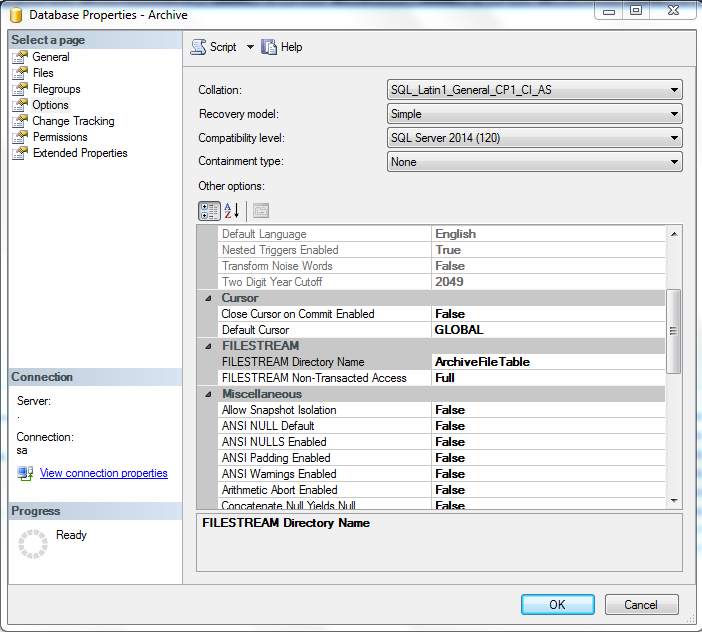
4) Specify FileStream Directory Name
Go to SQL Server Management Studio, select database -> Properties -> Options ->FileStream -> FileStream Directory Name -> Provide Any Name
5) Create FileTable
USE Archive
IF OBJECT_ID('dbo.TestFileTable', 'U') IS NOT NULL
DROP TABLE dbo.TestFileTable
GO
CREATE TABLE dbo.TestFileTable AS FILETABLE
WITH
(
FILETABLE_DIRECTORY = 'ArchiveFileTable', --This name must be the name given in 3rd Step
FILETABLE_COLLATE_FILENAME = database_default
)
GO
6) Add Files to your FileTable
There are three ways you can do this.
- Drag and drop files from the source folders to the new FileTable folder in Windows Explorer.
- Use command line options such as MOVE, COPY, XCOPY, or ROBOCOPY from the command prompt or in a batch file or script.
- Write a custom application in C# or Visual Basic.NET that uses methods from the System.IO namespace to move or copy the files.


7) Insert Files to your FileTable using TSQL
INSERT INTO [dbo].[TestFileTable]([name],[file_stream])SELECT'NewFile.txt', * FROM OPENROWSET(BULK N'd:\NewFile.txt', SINGLE_BLOB)AS FileData
GO
GO


Comments
Post a Comment